Images of Diego Rivera Murals Images Famous Art Mexican Peasants in Field
Before the Spanish conquest in the 16th century, Mexico came under a region now known as Mesoamerica. Mesoamerican fine art was strongly based on nature, the surrounding political reality and the gods. Afterward the Spanish conquest, fine art in United mexican states was primarily used as a mean to propagate Christianity. Notwithstanding, after Mexico won its independence from Spain in 1821, the nation'southward art featured the heroes of its independence; and indigenous themes began to appear in paintings and sculptures. The Mexican Revolution, which took place from 1910 to 1920, radically transformed Mexican culture; and it had a deep and profound affect on Mexican art. The Mexican muralism movement then dominated the Mexican art scene; and from 1920s to 1970s, numerous murals with nationalistic, social and political letters were created on public buildings. Mexican fine art has continued to evolve with artists exploring unfamiliar territories and carving out their ain identity separate from European influences. Hither are the 10 most famous paintings by Mexican artists.
#ten Echo of a Scream
Spanish Title: Eco de un grito
Artist: David Alfaro Siqueiros
Year: 1937
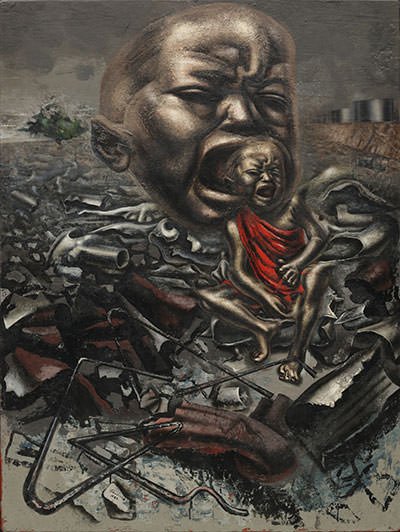
Along with Diego Rivera and José Clemente Orozco, David Alfaro Siqueiros is regarded as 1 of the "los tres grandes" (three greats) of Mexican muralism. The most radical of the 3, Siqueiros is renowned for his depictions of human struggle against disciplinarian regime. His near famous work, Echo of a Scream depicts the bleakness, despair and destruction of war. Painted at the time of the Castilian Ceremonious War, it is a captivating piece of work which visually and metaphorically captures human being suffering during war. The most prominent figure in the painting is an enlarged head of a crying babe and another crying infant is coming out of his mouth. Among other things, shells, cleaved canons and shrapnel are spread on the footing portraying the fallout of war. Echo of a Scream is i of the most famous Mexican anti-war paintings.
#ix Three People
Spanish Title: Tres Personajes
Artist: Rufino Tamayo
Year: 1970
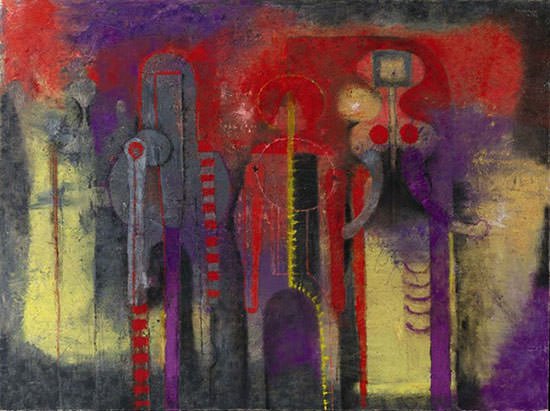
Tres Personajes is the best known piece of work of Rufino Tamayo, who is regarded as one of the greatest Mexican painters of the 20th century. A masterpiece of abstruse art, this painting depicts a man, a woman and an androgynous effigy. Tamayo has used his signature rough surface texture, made of sand and ground marble dust mixed into the pigment. Also, vibrant shades of purple, orange and yellow have been employed to add splendor to the painting. In 1977, Tres Personajes was bought by a resident of Huston, Texas for his married woman at a price $55,000. The painting was stolen in 1987 but was found in 2003 past a New York resident who received a reward of $15,000 USD.
#viii Self-Portrait: The Inn of the Dawn Equus caballus
Spanish Title: La posada del Caballo del Alba
Artist: Leonora Carrington
Year: 1938
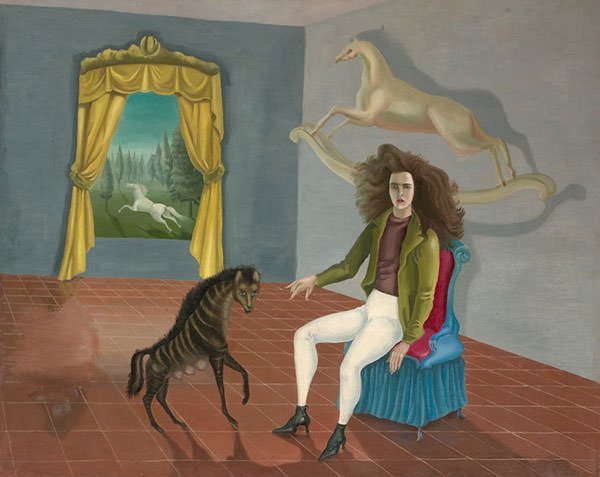
Considering that renowned Mexican painter Frida Kahlo declared that she was not a Surrealist, Leonora Carrington is peradventure the most famous female Surrealist artist. Dissimilar the other Surrealists, Carrington was not interested in the writings of Sigmund Freud. She is instead famous for her haunting, autobiographical paintings that incorporate images of sorcery, metamorphosis, alchemy and the occult. This self-portrait, also known as The Inn of the Dawn Equus caballus, is her about acclaimed piece of work. In it, she has painted herself posed in the foreground on a blue armchair with her hand pointing toward a female hyena. A white rocking horse appears to float on the wall behind her head while a white equus caballus gallops freely in the window in the background. The distorted perspective, the mysterious narrative and autobiographical symbolism of this portrait perchance demonstrate the artist's endeavour to reimagine her own reality.
#7 Detroit Industry Murals
Castilian Title: Murales de la industria de Detroit
Creative person: Diego Rivera
Year: 1933
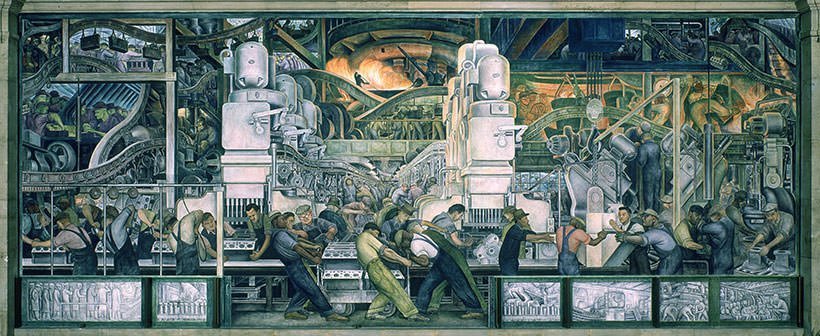
Considered a genius who could turn his hand to whatsoever manner including Impressionist, Post-Impressionist, Cubist and Flemish, Diego Rivera believed that anybody should be able to view his fine art and hence he painted big murals on public buildings. In 1932, he was commissioned to paint twenty-vii frescoes in the Detroit Institute of Fine art in Midtown Detroit, Michigan, Usa. From the 27 murals that Rivera painted, the two largest murals are located on the north and s walls. They depict laborers working at Ford Motor Company's River Rouge Plant. Other panels depict advances fabricated in various scientific fields, such every bit medicine and technology. Rivera considered the Detroit Industry Murals to be his most successful piece of work. In 2014, the murals were given National Celebrated Landmark Status.
#6 The Cleaved Column
Spanish Title: La Columna Rota
Artist: Frida Kahlo
Year: 1944
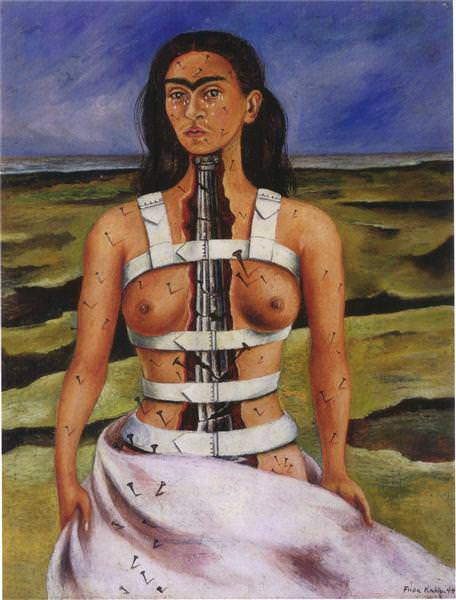
On 17th September 1925, Frida Kahlo and her friend Alex were riding in a bus when it crashed into a street trolley automobile. Due to the grave injuries she suffered in the accident, Frida had to undergo 35 operations in her life, behave with relapses of extreme pain and could not have children. Kahlo'southward works oft describe the trauma she had to go through in her life and this work is the most conspicuous portrayal of her suffering. In this masterpiece Kahlo'south body is opened upward and a crumbling rock column replaces the spine of Kahlo, symbolizing the consequences of the blow. Nails are stuck into her face and body and tears can be seen on her face up but she looks directly at the viewer. The Broken Column is the most straightforward and ruthless depiction of the agony Kahlo faced through her life.
#5 Man at the Crossroads
Castilian Championship: El Hombre en la encrucijada
Artist: Diego Rivera
Year: 1934
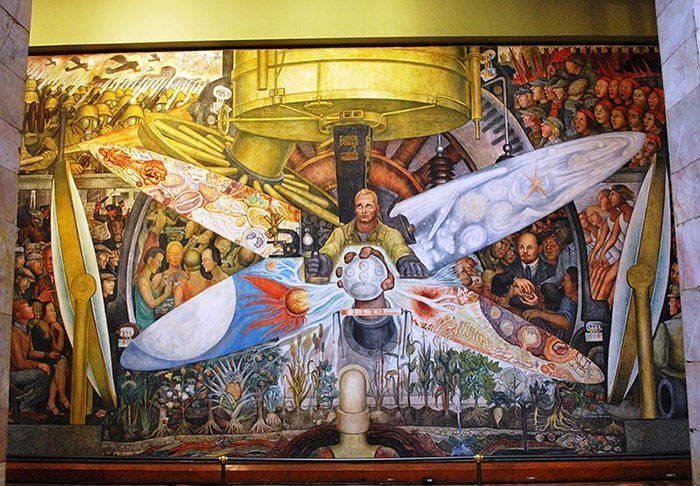
This fresco was showtime commissioned by the Rockefellers for footing-floor wall of Rockefeller Center in New York City. Nevertheless it couldn't be completed as Rivera refused to remove a portrait of Lenin which was causing a controversy. It was subsequently destroyed just Rivera had blackness-and-white photographs of information technology. Using these, he recreated a nearly identical mural at the Palacio de Bellas Artes in United mexican states City. It was renamed Human, Controller of the Universe. At the center of this masterpiece is a workman controlling mechanism with a fist holding an orb in forepart of him. 4 propeller-like shapes stretch from center to corner of the composition representing discoveries made possible by science. The limerick also depicts a contrast between Capitalism and Socialism with wealthy people playing cards and smoking in the left while on the right Lenin is seen belongings hands with a multi-racial group of workers. Man at the Crossroads is definitely the most renowned masterpiece by Diego Rivera.
#4 La Calavera Catrina
English language Title: The Elegant Skull
Artist: José Guadalupe Posada
Year: 1913
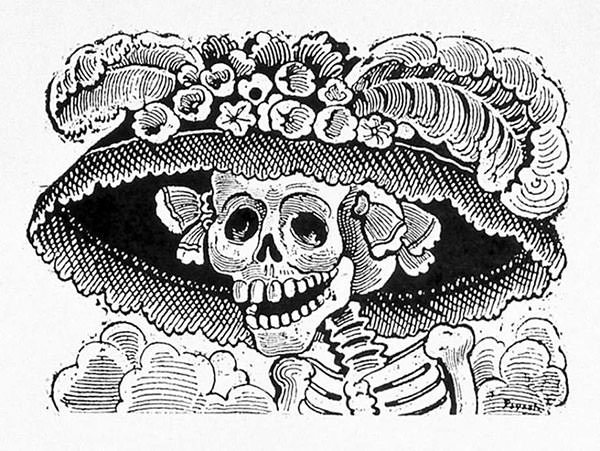
José Guadalupe Posada is considered a hugely influential political printmaker and engraver due to his satirical acuteness and social date. His near famous work, La Calavera Catrina depicts a tall, elegantly attired female skeleton wearing an extravagantly decorated hat. The portrait is considered a satirical delineation of those Mexican citizens who were ashamed of their indigenous origins and instead aspired to prefer European traditions. The Twenty-four hours of the Dead is a popular Mexican holiday in which family unit and friends gather and remember those who take lost their lives. La Calavera Catrina has go an icon of the Solar day of the Dead and it is common to come across her embodied equally part of Solar day of the Dead celebrations throughout the country. Now a part of Mexican culture, La Calavera Catrina is inspired from Mictecacihuatl, the Aztec "goddess of death and Lady of Mictlan, the underworld."
#3 Self-Portrait with Thorn Necklace and Hummingbird
S panish Title: Autorretrato con Collar de Espinas
A rtist: Frida Kahlo
Year: 1940
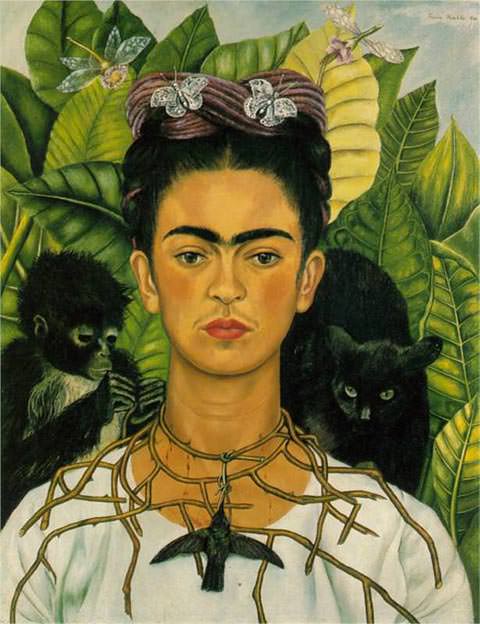
Frida Kahlo is known for symbolically portraying her concrete and psychological wounds through her cocky-portraits and this painting is a prime case of that. In it Kahlo is wearing a thorn necklace and blood can exist seen tricking from the wounds fabricated on her cervix by the thorns. A blackness monkey and a black cat are present on left and right side of her; and a h ummingbird is hanging lifelessly from the thorn necklace. Kahlo identified herself with indigenous Mexican civilization and this is apparent in the portrait. The black panther is symbolic of bad luck and death; the monkey is a symbol of evil; and the hummingbird, which is dead, is a symbol of liberty and love. The painting may be seen as placing Kahlo amid symbols of colonial and male person repression. Cocky-Portrait with Thorn Necklace and Hummingbird is amidst Kahlo's virtually celebrated masterpieces.
#two Our Lady of Guadalupe
S panish Championship: Nuestra Señora de Guadalupe
Yr: 1531

According to fable, Blessed Virgin Mary appeared in Mexico before a 57-year old peasant named Juan Diego, who was an Aztec convert to Christianity. She requested that a shrine to her be built on the spot. However, the archbishop asked for proof. When Juan Diego returned to Mary and told her this, she instructed him to climb to the top of the hill and gather flowers. At the top of the hill, Juan Diego plant Castilian roses, which were neither in season nor native to the region. Virgin Mary arranged the flowers herself in Juan Diego's tilma (a burlap-type cloak). She so told Diego to open up the cloak only upon his return to the bishop. When Diego did and so, the flowers fell to the floor and left on the surface of the tilma the image at present known as Our Lady of Guadalupe. The image is at present enshrined within the Minor Basilica of Our Lady of Guadalupe in Mexico City. Our Lady of Guadalupe has become a national symbol of Mexico and information technology has made the basilica the most visited Catholic pilgrimage site in the world.
#i The Two Fridas
Spanish Title: Las dos Fridas
Artist: Frida Kahlo
Twelvemonth: 1939
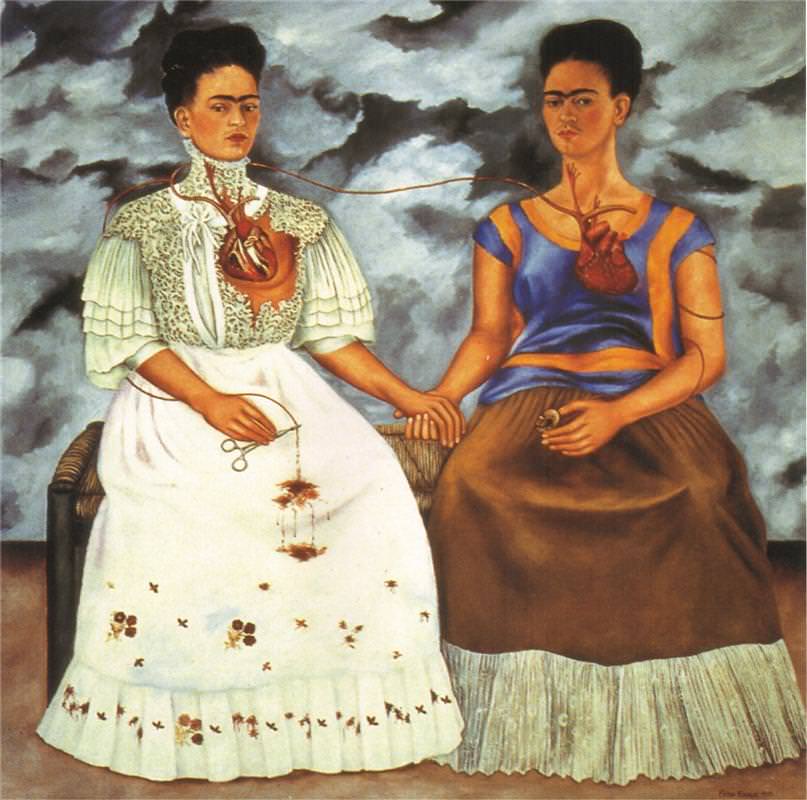
Frida Kahlo is the nearly famous Mexican creative person and one of the greatest artists in self-portraiture of all time. She had a tumultuous relationship with another famous Mexican painter Diego Rivera during which they married, divorced and re-married. The Two Fridas was created around the fourth dimension of Kahlo's divorce to Diego Rivera and it is believed it portrays her loss. It is a double self-portrait. Frida on the left is wearing a white European manner dress with her heart torn and haemorrhage while Frida on the right is wearing a traditional Mexican dress with her heart however whole. Kahlo remarried Rivera a twelvemonth subsequently and although their second spousal relationship was as troubled as the first, information technology lasted till her death. Las dos Fridas is the largest work of Kahlo and it is perchance the most famous painting by a Mexican creative person.
0 Response to "Images of Diego Rivera Murals Images Famous Art Mexican Peasants in Field"
Post a Comment